Web Shell Daemon Adapter
Goal
Web chat and web terminal clients should consume qwen serve through the
daemon HTTP/SSE APIs and render a client-side transcript. Native local TUI,
channel, and IDE integrations keep their existing default paths for now.
Interface terminology
This terminology update covers the sidebar workspace heading and workspace creation/management labels, ordinary session-creation actions (including the workspace overview and shared Managed workspace row action), the Recent heading, and the workspace Memory scope. On these surfaces, the labels use Workspaces / 工作区, New session / 新建会话, and Recent / 最近; a single directory-backed entry uses Workspace / 工作区. The Memory scope uses Workspace / 工作区级, retaining the Chinese scope-level suffix.
This is not a product-wide terminology migration. Existing Managed-agent page copy and registration-dialog copy (including 工作空间), the session-source Tasks / 任务 tab, workspace execution hints, offline-host hints, and other session help text retain their existing wording. Agent, Skills, Workflow, MCP, and approval scope labels are outside this update. Scheduled tasks, todo items, agent/tool executions, external services’ projects, and Git worktrees retain their domain meanings. The No-workspace sessions / 无工作区会话 group retains its name and placement; its naming and hierarchy are separate follow-up work.
Existing translation keys, SDK/API fields, stored identifiers, configuration
keys, and runtime logic are unchanged. Label-derived DOM values do change,
including dialog aria-label, data-web-shell-dialog-title, and button
accessible names. Automation matching the old text must update its selectors;
for example, the dialog title is now Add workspace, not Add Workspace.
The sidebar trigger, dialog heading, and non-browse submit button all use
Add workspace; scope text-based dialog selectors to
[data-web-shell-dialog] to distinguish them from the background trigger.
The Recent heading and its region name continue to share the same translation
key; a separate descriptive region label is outside this copy-only update.
Sidebar category headers
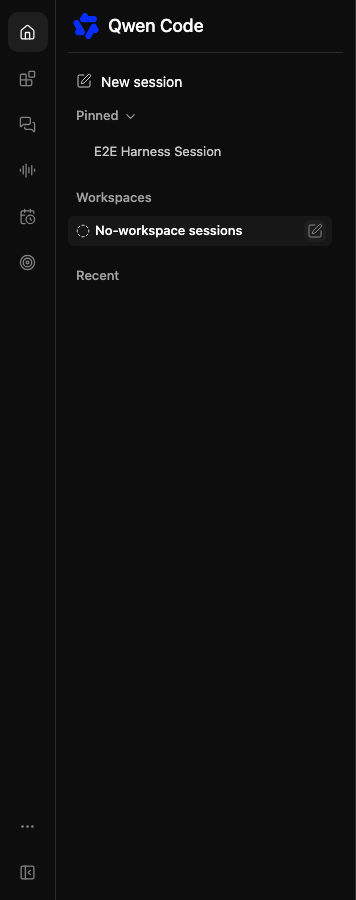
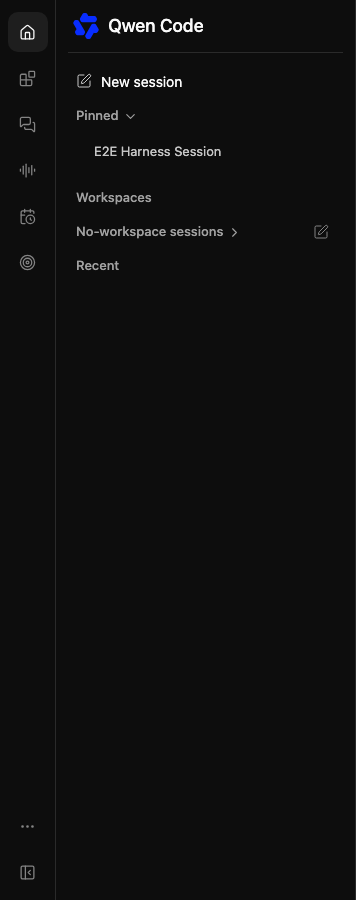
Pinned, Workspaces, No-workspace sessions, and Recent are peer collapsible categories. Their active sidebar headers use the same height, spacing, muted text, and trailing expansion chevron, including hover and keyboard-focus reveal rules. No-workspace sessions retains its independent saved expansion preference and search behavior. Its header in Archived settings keeps the workspace-entry presentation.
Chromium comparison with simulated daemon responses (hovering the collapsed No-workspace sessions category):
| Before | After |
|---|---|
 |  |
Shared UI Contract
Use the TypeScript SDK daemon UI exports as the common boundary:
import {
  DaemonClient,
  DaemonSessionClient,
  createDaemonTranscriptStore,
  normalizeDaemonEvent,
} from '@qwen-code/sdk/daemon';
The split is:
DaemonClienthandles daemon HTTP routes.DaemonSessionClientowns session creation/attachment and SSE replay.normalizeDaemonEvent()converts daemon wire events into UI events.createDaemonTranscriptStore()reduces UI events into transcript blocks.
React clients can use the binding exported by Web Shell:
import {
  DaemonSessionProvider,
  useActions,
  useConnection,
  usePendingPermissions,
  useTranscriptBlocks,
} from '@qwen-code/web-shell/daemon-react-sdk';
Minimal React shape:
function App() {
  return (
    <DaemonSessionProvider baseUrl="http://127.0.0.1:4170">
      <Transcript />
      <PromptBox />
    </DaemonSessionProvider>
  );
}

function Transcript() {
  const blocks = useTranscriptBlocks();
  return blocks.map((block) => <RenderBlock key={block.id} block={block} />);
}
The provider creates or attaches a daemon session, subscribes to SSE, keeps the
last event id on DaemonSessionClient, and reconnects the stream by default.
Callers can disable that with autoReconnect={false} for tests or custom
connection management.
Removing composer attachments
In the desktop Web Shell composer, when the text body is empty and the caret is at its start with no selection, Backspace or Delete first removes a removable context tag using that key’s existing order. If no removable context tag remains, it removes the last file attachment, or the last pasted image when there are no files. File and image attachments are retained while the text body is non-empty. Attachments can also be removed using their individual remove buttons.
Browser Deployment Shapes
Same-Origin Local POC
A daemon-served page can call the daemon directly because the page and API share one origin. This is the preferred early POC shape for local web chat and web terminal validation.
Remote Web Chat / Web Terminal
A production remote web app should normally talk to a backend-for-frontend. The BFF owns daemon URL, token, workspace routing, and session metadata, then forwards browser-safe app events to the browser. This keeps bearer tokens out of browser storage and lets the deployment decide which daemon/workspace a user is allowed to reach.
Local Browser Against Local Daemon
A separate local dev server is cross-origin from qwen serve; it must either
proxy daemon routes through the same origin or be served by the daemon. The
daemon intentionally rejects arbitrary browser Origin requests.
Rendering Responsibilities
Web Shell highlights line-leading slash tokens such as /review in user
messages with the same blue, bold treatment as the composer. Highlighting is
derived from the recorded text, so it also applies when reopening a session.
It is a syntax cue, not confirmation that a command exists or executed.
Message text, clickable URLs, and annotated reference chips are preserved.
The shared transcript model is semantic, not visual. UI clients decide how to render:
- user and assistant message blocks
- collapsed thought blocks
- tool status cards
- shell output blocks
- permission request controls
- status/error/debug blocks
The web terminal is a browser-native semantic renderer. It should look and feel terminal-like with monospace layout, scrollback, prompt input, shortcuts, and streaming blocks, but it is not a raw PTY proxy and does not require server-side Ink rendering.
Merge Safety
- The native
qwenTUI remains direct and unchanged. --acp, channel, and IDE paths remain unchanged by default.- The SDK UI core is additive.
- The Web Shell React binding is optional and only runs in clients that import it.
- Removed daemon TUI spike code should not be treated as a product migration.
Follow-Ups
- Keep the daemon-served Web Shell and embedded IDE host behavior aligned.
- Continue building first-class chat and terminal renderers on transcript blocks.
- Add richer typed events only where existing daemon events are too low-level for stable browser UI behavior.
- Consider a dedicated
@qwen-code/daemon-ui-corepackage if non-SDK consumers need the UI core as an independent dependency.